Explainers
What Is One Tray of Eggs in India?
One tray holds 30 eggs — and that is the hinge of the entire Indian egg trade. Here is every unit, who uses which, and how to price any of them yourself.
5 min read · Explainers
One tray of eggs in India holds 30 eggs. Six across, five down, in a moulded pulp tray. It is the single most common unit in the Indian egg trade — the thing a retailer buys in, the thing a household carries home, and the unit almost everyone means when they ask “what is the egg rate today”.
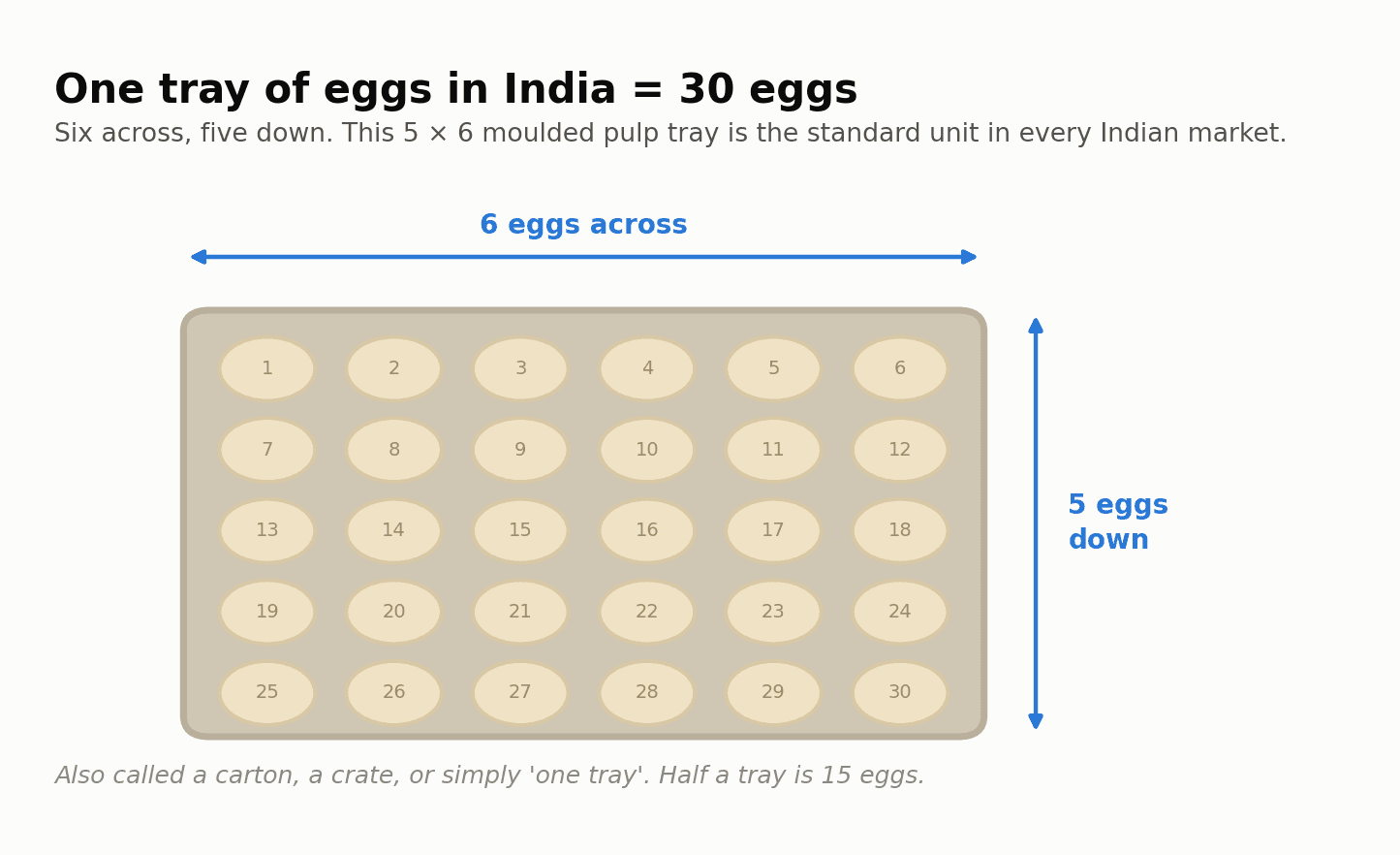
Every unit the Indian egg trade uses
| Unit | Eggs | Also called | Who uses it |
|---|---|---|---|
| Piece | 1 | Loose egg, single | Households, tea stalls |
| Half tray | 15 | Aadha tray | Small households |
| Tray | 30 | Carton, crate, trey | Retailers, households — the default unit |
| Per 100 | 100 | Hundred pieces | Wholesale quotations |
| Peti | 210 | Petti, case, box | Bulk trade and transport |
Two of these matter most. The tray is what you buy. The peti is what moves between cities.
What is a peti?
A peti is 210 eggs — seven trays stacked in one box.
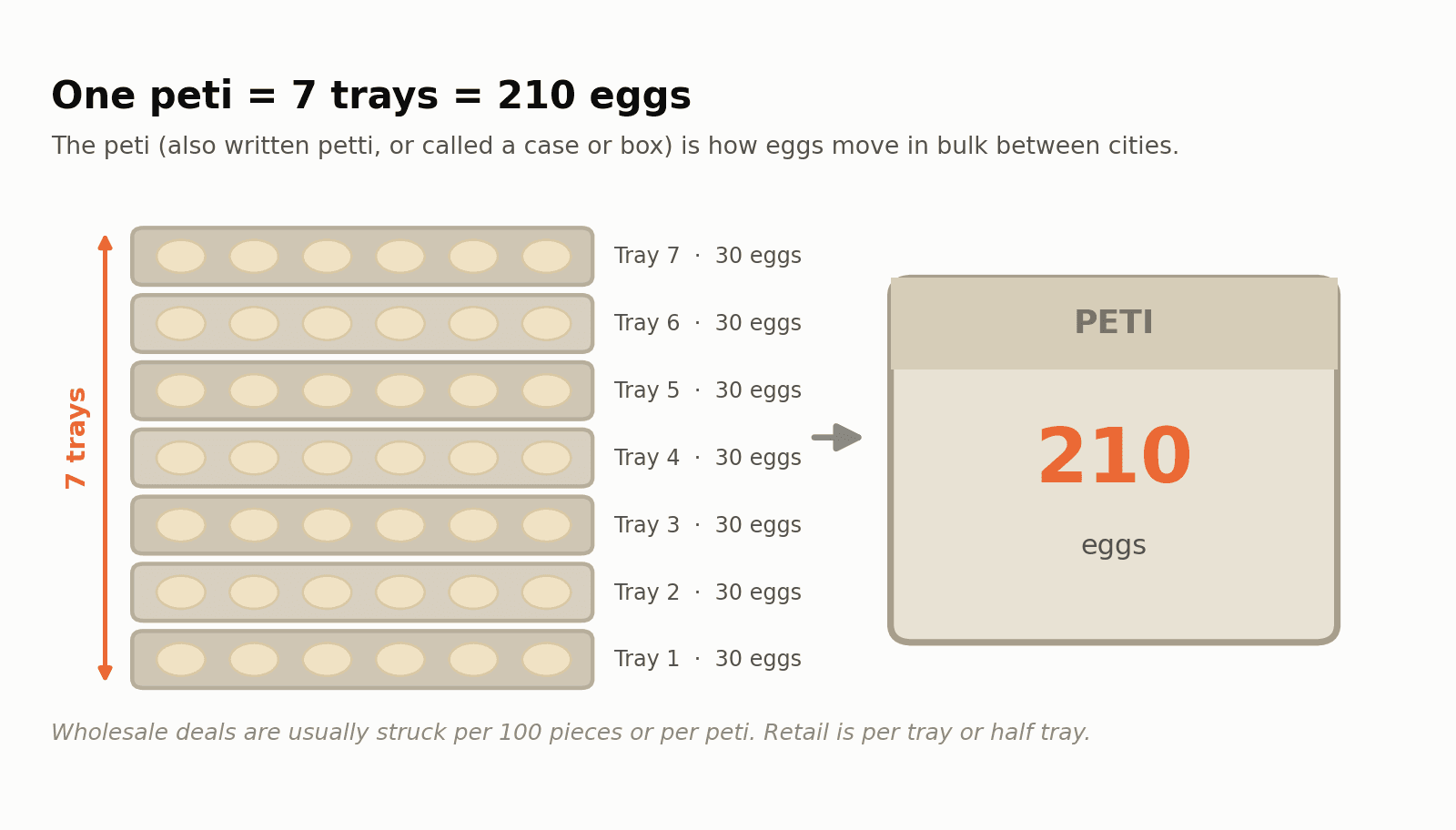
If you have heard a trader say “peti ka rate kya hai”, this is the unit they mean. Truck loads, cold-storage stock and inter-state consignments are all counted in petis, not trays. Spellings vary — peti, petti, paeti — but the count does not.
Who buys in which unit
The chain from hen to kitchen changes unit at each step, and the tray sits right in the middle of it.
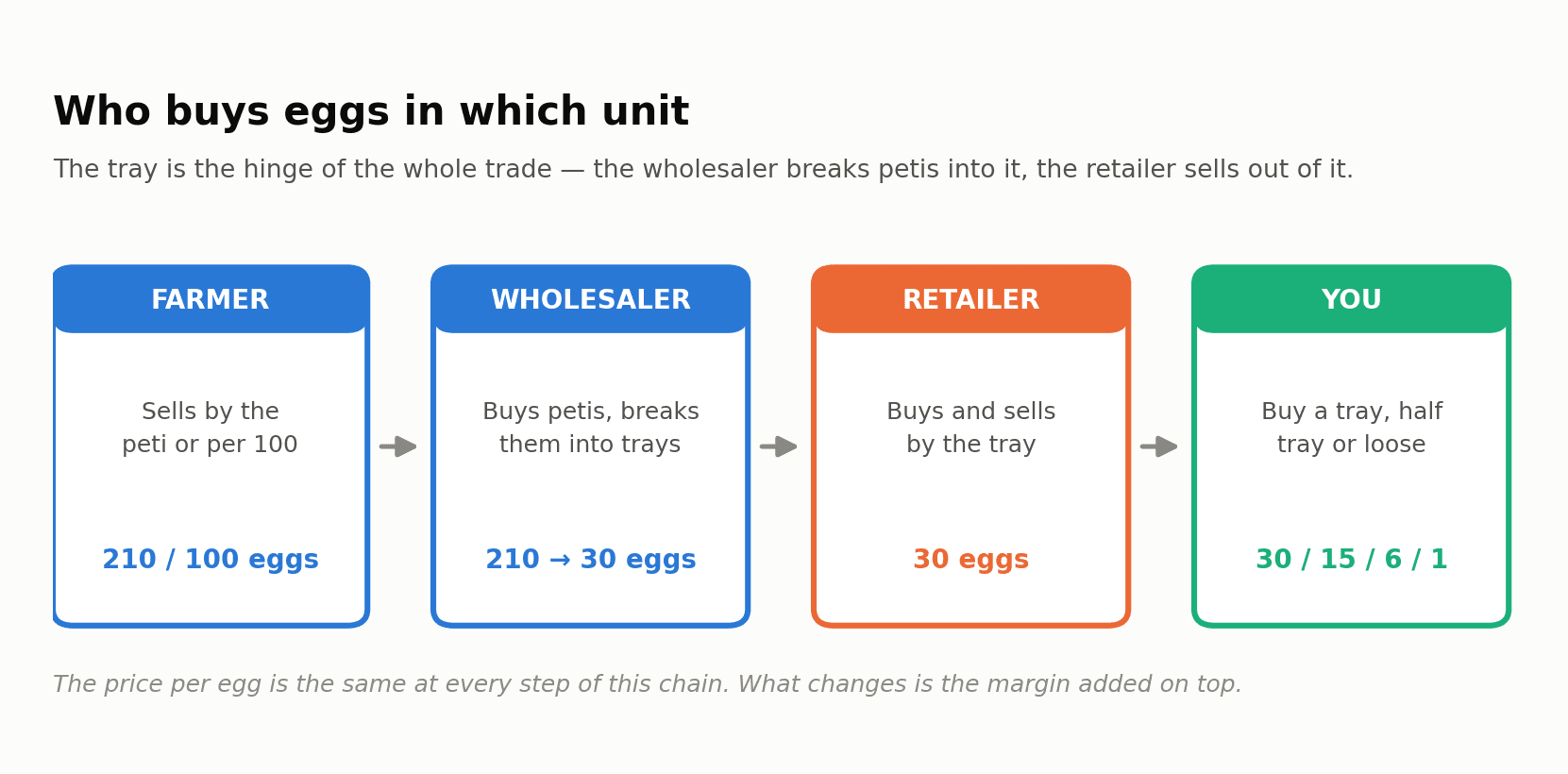
- Farmer sells in petis or per 100. Nobody sells 30 eggs off a farm.
- Wholesaler buys petis and breaks them down into trays.
- Retailer buys trays and sells trays, half trays, or loose.
- You buy whichever suits your kitchen.
The NECC rate — the daily reference price — is quoted per egg. Everything else is just multiplication. (How that daily rate gets decided is its own story.)
How to price any unit yourself
Take the NECC per-egg rate for your city and multiply:
| To get | Multiply per-egg rate by |
|---|---|
| Half tray | 15 |
| Tray of 30 | 30 |
| Per 100 | 100 |
| Peti of 210 | 210 |
Worked example at the India average of ₹5.81 per egg (20 September 2026):
- Half tray (15) — about ₹87.15
- Tray of 30 — about ₹174.30
- Per 100 — about ₹581
- Peti of 210 — about ₹1,220.10
There is no bulk discount hidden in the NECC rate. A peti costs exactly seven trays’ worth. Any discount you get is negotiated with your seller, not built into the published rate.
Does the tray size change between states?
The count does not. Thirty eggs to a tray is standard from Ludhiana to Namakkal.
What changes is the vocabulary and the packaging around it:
| Region | Common words you’ll hear |
|---|---|
| North (Delhi, Punjab, Haryana, UP) | Tray, crate, peti for the box |
| West (Maharashtra, Gujarat) | Tray, carton, peti |
| South (AP, Telangana, TN, Karnataka) | Tray, peti, box; Telugu guddu for egg |
| East (WB, Bihar, Jharkhand, Odisha) | Tray, khancha (locally, for the tray), peti |
The material also varies. Most trays are moulded paper pulp — grey-brown, recyclable, the standard everywhere. Plastic trays turn up in modern retail and in farms that reuse them. Retail chains increasingly use clear plastic 6-egg and 12-egg packs, which are a retail pack, not a trade unit.
One genuine exception worth knowing: the dozen (12) is a retail-chain and e-commerce unit borrowed from Western packaging. It has no standing in the wholesale trade. If a trader quotes you “per dozen”, they have converted for your benefit — the trade itself does not think in twelves.
Frequently asked questions
How many eggs are in one tray in India?
Thirty. Arranged six across and five down in a moulded pulp tray.
How many eggs are in a peti?
210 eggs — seven trays of 30.
How many trays are in a peti?
Seven.
What is the price of one tray of eggs today?
Take your city's NECC rate per egg and multiply by 30. At the current India average of ₹5.81 per egg, a tray works out to roughly ₹174.30 wholesale. Check your city's exact rate on the homepage.
Is a tray the same as a crate or a carton?
Yes — all three words describe the same 30-egg unit in Indian usage.
How many eggs are in half a tray?
Fifteen.
Why does the trade use 210 and not 200?
Because a peti is defined by trays, not by round numbers. Seven trays of 30 comes to 210, and seven trays is what fits and stacks well in a standard box.
Is a dozen used in India?
Only in retail chains and online grocery. The wholesale trade quotes per piece, per 100, per tray or per peti.
Today’s NECC rate for all 34 markets, in every unit — per egg, per tray, per 100 and per peti: indiaeggrate.today