Plain-English guide
How Is the Egg Rate Decided in India?
A simple guide to NECC, e2necc.com, collection centres, and why a tray of eggs costs more in Ranchi than in Barwala.
10 min read · Explainers
This guide explains the whole system in simple words, with pictures. If you have five minutes, you will understand egg pricing in India better than most people in the trade.
1. Who decides the egg rate in India?
A farmers’ organisation called NECC does. Not the government, not a company, and not the shopkeeper.
What is NECC?
NECC stands for the National Egg Co-ordination Committee. It was started in May 1982 by a poultry farmer named Dr B. V. Rao. Today it has tens of thousands of farmer members.
It was born out of a problem. In the early 1980s, eggs were selling for less than what it cost to produce them. Farmers were losing money on every egg. So they joined hands and agreed to publish one common reference price each day, so that no single farmer could be squeezed by a buyer.
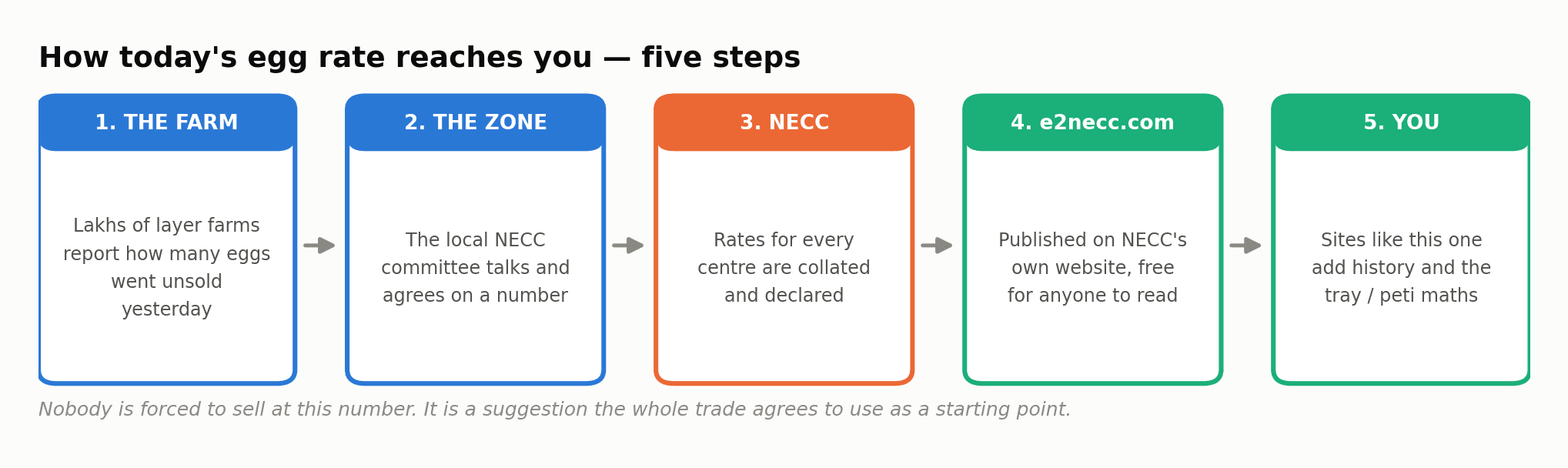
2. How does the rate travel from the farm to your phone?
In five steps. It usually takes a few hours.
3. What does NECC actually look at?
Three things, mainly. They are easy to remember.
- Leftovers. How many eggs were left unsold yesterday. Too many eggs left over means the price must come down. Very few left over means it can go up.
- Feed cost. A hen eats maize and soya every single day. Feed is roughly two-thirds of the cost of producing an egg. When maize gets dearer, the egg rate has to rise or farmers lose money.
- Demand. In December people eat more eggs and bakeries bake more cakes. In May, demand drops. The rate follows the crowd.
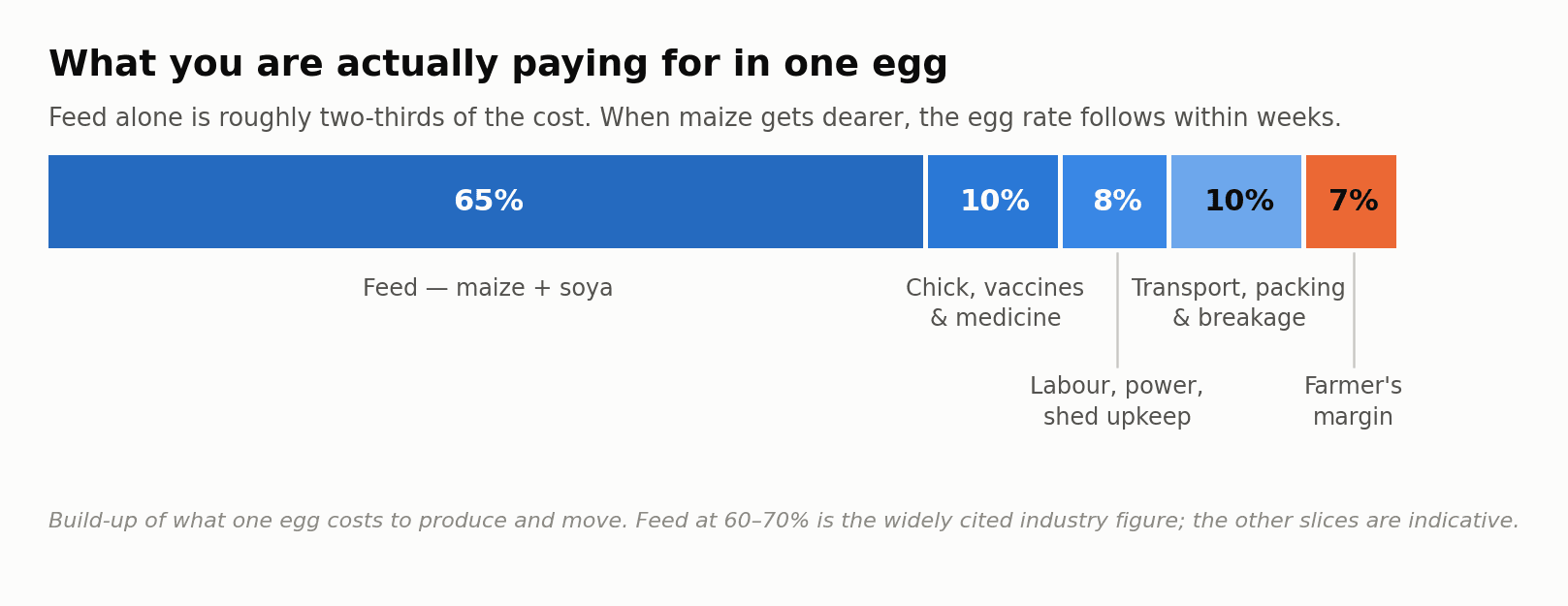
The egg rate is mostly a maize-and-soya story wearing an egg costume.
4. What is e2necc.com, and how does it work?
e2necc.com is NECC’s own official website. It is where the suggested rates are published each day. It is free — there is no login and no fee.
The site is deliberately plain. You will not find charts, animations or apps on it. What you will find is a simple table.
What the e2necc table shows
| On the page | What it means |
|---|---|
| A date at the top | The day these suggested rates apply to. Rates are for that day only. |
| A list of city names | Each name is one NECC market — a place where eggs are traded in large volume. |
| A number beside each city | The suggested rate. It is usually shown as rupees per 100 eggs, so “543” means ₹543 for 100 eggs — that is ₹5.43 per egg. |
| A “(CC)” tag beside some cities | This marks the big consuming cities — places that mainly eat eggs rather than produce them. |
| A “0” beside a city | No rate was declared for that market that day. It does not mean eggs are free. |
| A disclaimer at the bottom | A legal note saying the prices are only suggestions, not orders. |
5. What is a “collection centre”?
A collection centre is simply a city or town where enough eggs change hands every day that a price there means something. NECC picks these places and declares a rate for each one.
Not every town gets one. A village with two poultry farms will not have a rate. It follows the nearest big centre.
Two kinds of centres
| Production centre | Consumption centre | |
|---|---|---|
| What it is | A place surrounded by poultry farms. Eggs are born here. | A big city that eats eggs but does not lay many. |
| Examples | Namakkal, Barwala, East and West Godavari, Warangal, Hyderabad | Mumbai, Kolkata, Bengaluru, Chennai, Ranchi, Patna |
| Rate is usually | Lower — you are standing next to the hens | Higher — the eggs travelled by truck to get here |
| Why it matters | Sets the floor price for the whole region | Shows what the eating public actually pays wholesale |
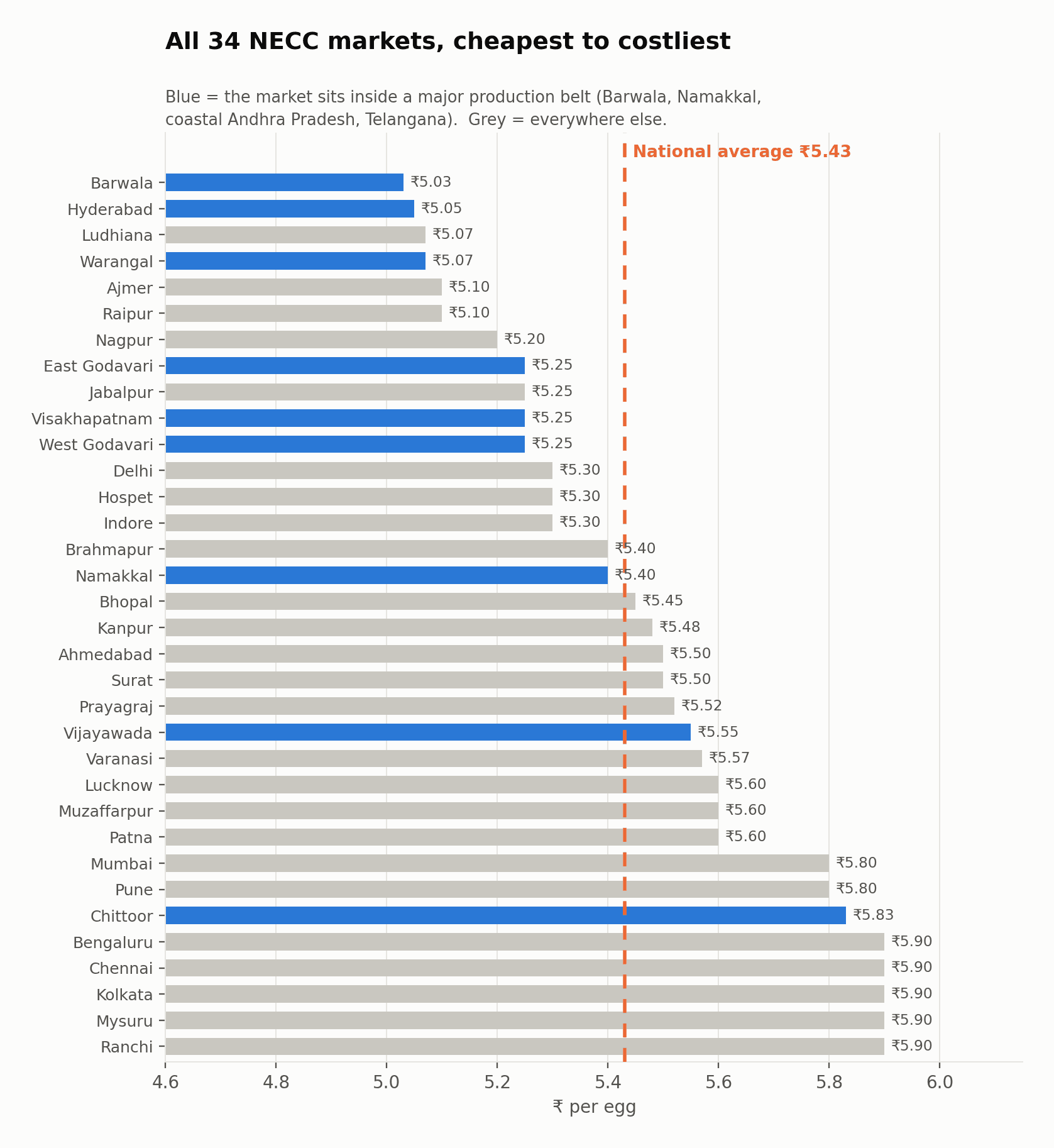
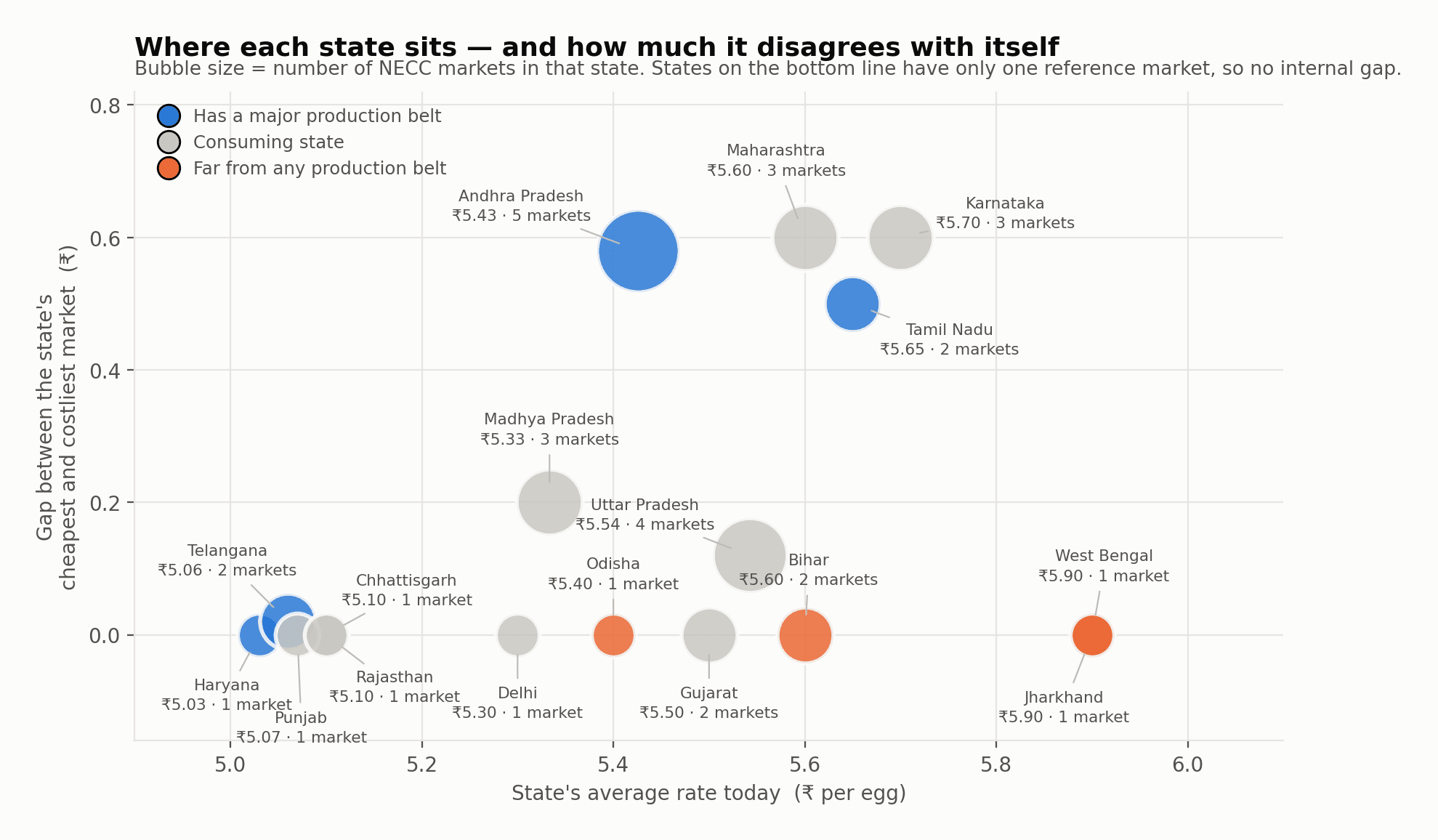
India has 34 such centres on NECC’s list today, spread across 17 states and union territories. Andhra Pradesh has the most — five. Eight have just one. You can see all of them on the map.
6. Why is the rate different in every city?
Because of one thing above all: distance from the hen.
India’s eggs are not laid everywhere. They come from a handful of belts — Namakkal in Tamil Nadu, the Godavari districts and Chittoor in Andhra Pradesh, Hyderabad and Warangal in Telangana, and Barwala in Haryana. Namakkal alone produces around six crore eggs a day.
If you live inside one of those belts, eggs are cheap. If you live far away — Ranchi, Kolkata, Patna — every egg has ridden a truck for hundreds of kilometres, and you pay for that ride.

7. Why does the rate change through the year?
Hens lay at roughly the same pace all year. People do not eat at the same pace all year. That gap is the whole story.
- Winter (Nov–Jan). People eat more eggs to stay warm, bakeries bake more cakes for Christmas and New Year, and demand jumps. Rates peak.
- Summer (Mar–May). Heat cuts appetite, schools close, and egg demand sags. Rates fall to their lowest.
- Vegetarian seasons. Shravan, Navratri and similar periods pull demand down sharply in specific regions for a few weeks.
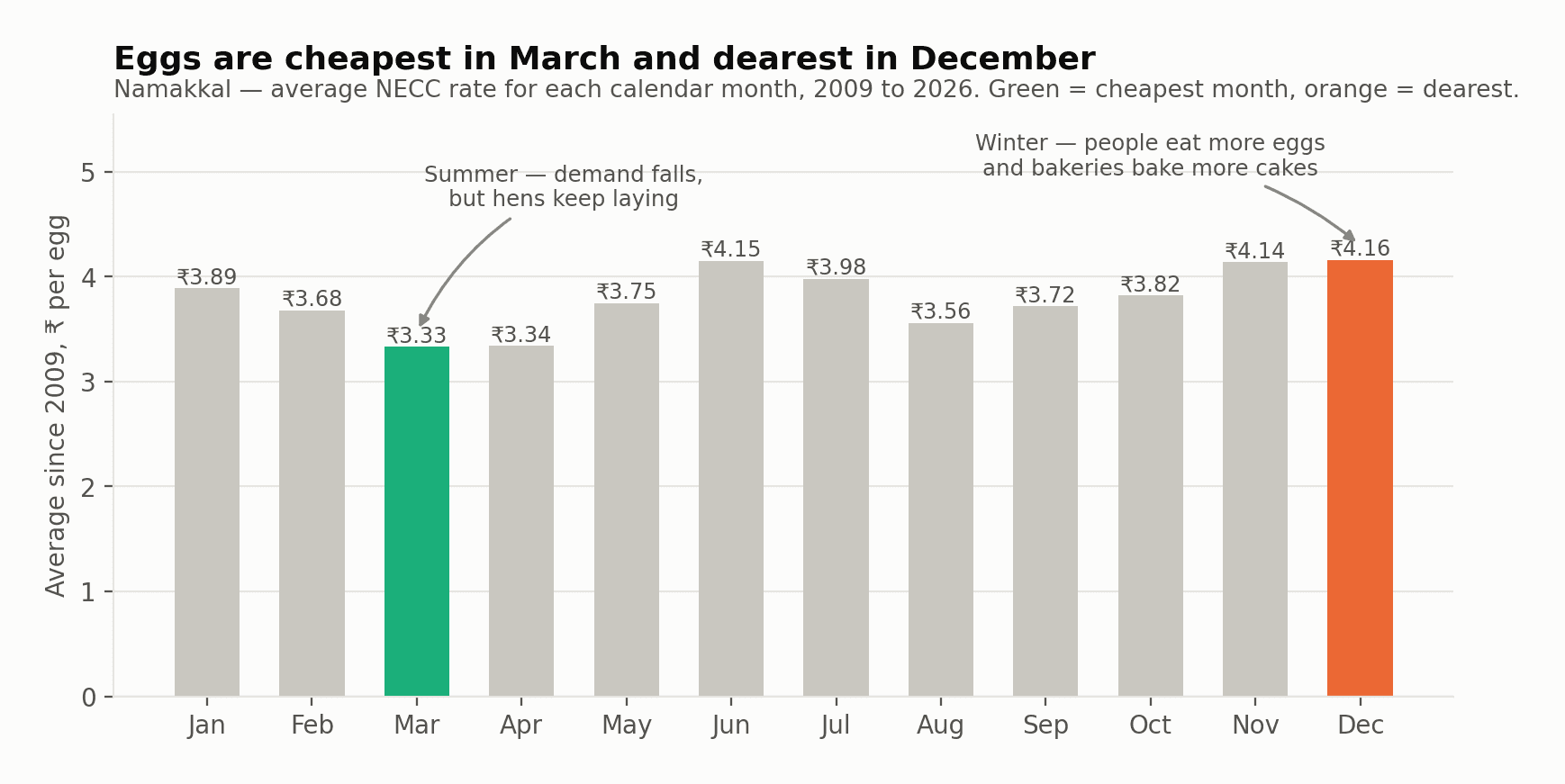
This chart is genuinely useful if you buy eggs in bulk. If you run a bakery or a hostel mess, your cheapest buying window is March and April, and your most expensive is December. Every market page on this site carries its own version of it.
8. Tray, peti, per 100 — what do these words mean?
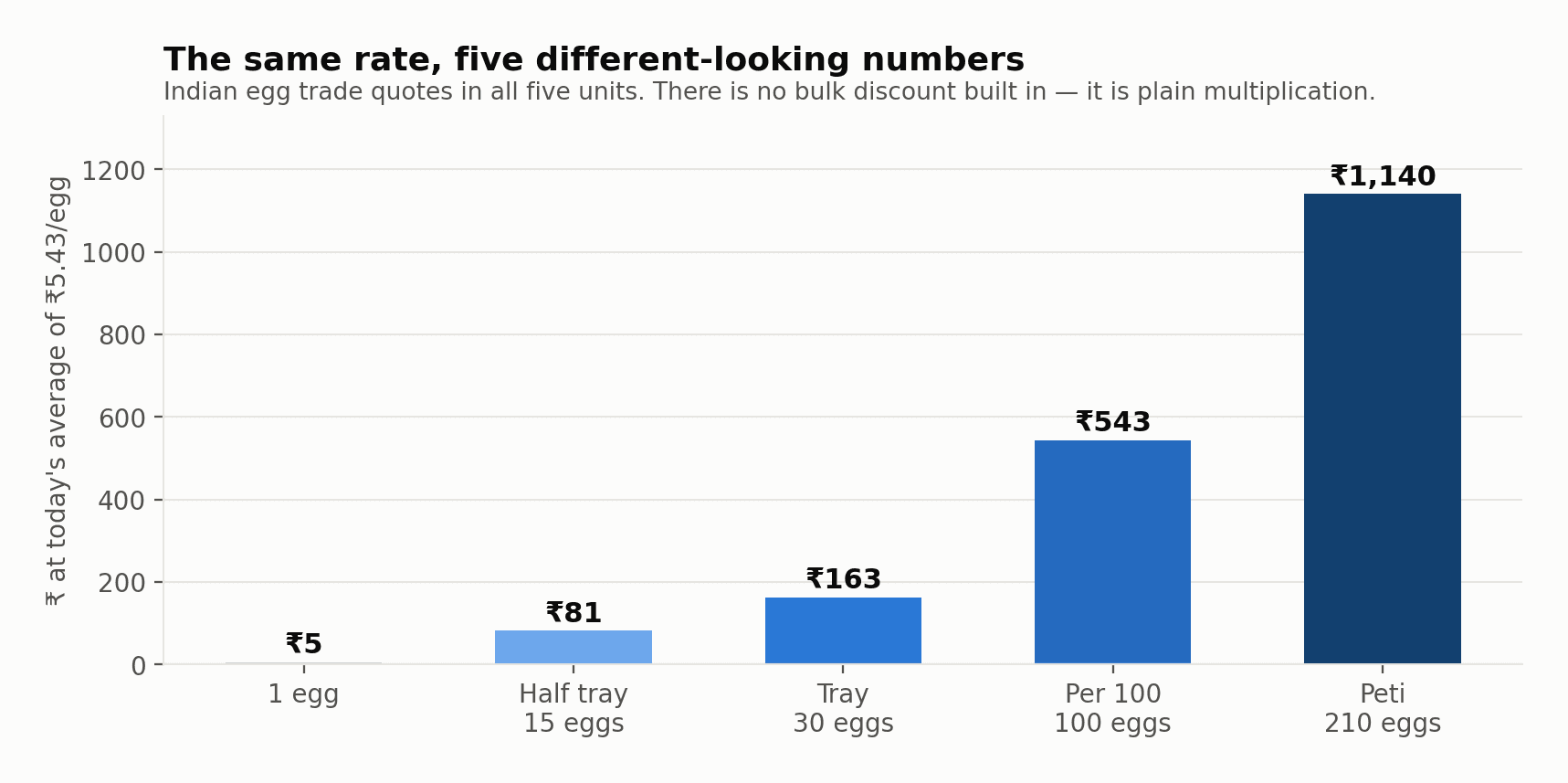
The Indian egg trade quotes the same price in five different ways. This confuses almost everybody. Here it is, once and for all — and there is a full explainer on the units if you want the details.
| Unit | How many eggs | Who uses it |
|---|---|---|
| 1 piece | 1 | The base NECC quote |
| Half tray | 15 | Small households |
| Tray (also carton, crate) | 30 | Households, small shops — the most common unit |
| Per 100 | 100 | Wholesale deals |
| Peti (also petti, case, box) | 210 (7 trays) | Bulk trade, transport |
9. Is the NECC rate compulsory? No — and there is a reason it says so
Every NECC page carries a line saying its prices are “merely suggestive and not mandatory”. That sentence has a history.
In January 2022, India’s competition watchdog, the Competition Commission of India (CCI), examined how NECC declared its rates. It found that the system had gone beyond suggestion — that rates were being set by zonal chairmen and circulated in a way that discouraged farmers from selling below them.
The CCI held this to be price-fixing under the Competition Act, 2002. It did not shut NECC down. It directed NECC to carry a clear disclaimer that the prices are only suggestions, to stop pressuring members over price, and to train its members on competition law.
10. Common questions
Who sets the egg rate in India?
NECC, the National Egg Co-ordination Committee, a farmers' body founded in 1982. It suggests a rate each day for each major market; it does not command one. The government plays no role in fixing egg prices in India.
Is the egg rate today the same all over India?
No. On a typical day the cheapest and costliest NECC markets are about 80 to 90 paise apart per egg, which is roughly 25 rupees on a tray of 30.
What is the difference between the NECC rate and the shop rate?
The NECC rate is a wholesale reference at the market. The shop rate adds transport to the shop, handling, breakage and the shopkeeper's margin, so retail prices are almost always higher.
Is the NECC rate quoted per egg or per tray?
Neither — it is quoted per 100 eggs, and NECC also publishes a paise-per-egg figure. A tray of 30 and a peti of 210 are packing units, not pricing units, so a tray price is always the per-100 rate converted.
Why is the egg rate high in Ranchi and low in Barwala?
Barwala is surrounded by poultry farms, so eggs are cheap at source. Ranchi has no nearby production belt, so its eggs arrive by truck from hundreds of kilometres away and the freight shows up in the price.
Does the egg rate follow the same pattern every year?
Broadly, yes. Rates usually peak in December, when winter demand and festive baking meet, and bottom out around March and April, when demand falls in the heat while hens keep laying at the same rate. The archive runs back to 2009, so you can check that pattern market by market rather than take it on trust.
Is the NECC egg rate compulsory?
No. NECC rates are suggested prices published for the information of the trade. Following an order of the Competition Commission of India in January 2022, NECC carries a clear disclaimer that its prices are merely suggestive and not mandatory.
Does NECC decide brown egg and white egg prices separately?
The daily NECC rate refers to the standard white table egg. Brown eggs and speciality eggs are priced separately by sellers and are typically dearer.
Where can I see the official NECC egg rate?
On NECC's own website, e2necc.com. For the same rate with charts, price history back to 2009 and tray or peti conversions, use indiaeggrate.today.
11. Words you will hear in the egg trade
| NECC | National Egg Co-ordination Committee — the farmers' body that suggests the daily rate |
|---|---|
| Collection centre | A city or town where NECC declares a rate because enough eggs trade there |
| Production centre | A centre surrounded by poultry farms — eggs come from here |
| Consumption centre | A big city that mostly eats eggs rather than producing them |
| Layer | A hen kept for laying eggs (as opposed to a broiler, kept for meat) |
| Peti | A case of 210 eggs — seven trays |
| Tray | Thirty eggs in a moulded carton |
| Table egg | An ordinary egg meant for eating, not for hatching |
| Farm gate price | What the farmer actually receives, before any trader's margin |
| Cull bird | A hen sold for meat once she stops laying well |
The full glossary has forty terms, each with its own anchor.
Check today’s rate for your city. Daily NECC rates for all 34 markets, with charts back to 2009 — indiaeggrate.today