Explainers
Why Do Egg Prices Change Every Day in India?
A hen lays one egg a day, eggs cannot be stored, and India keeps no reserve stock. So when demand moves, the price is the only thing left that can move.
4 min read · हिंदी में भी उपलब्ध
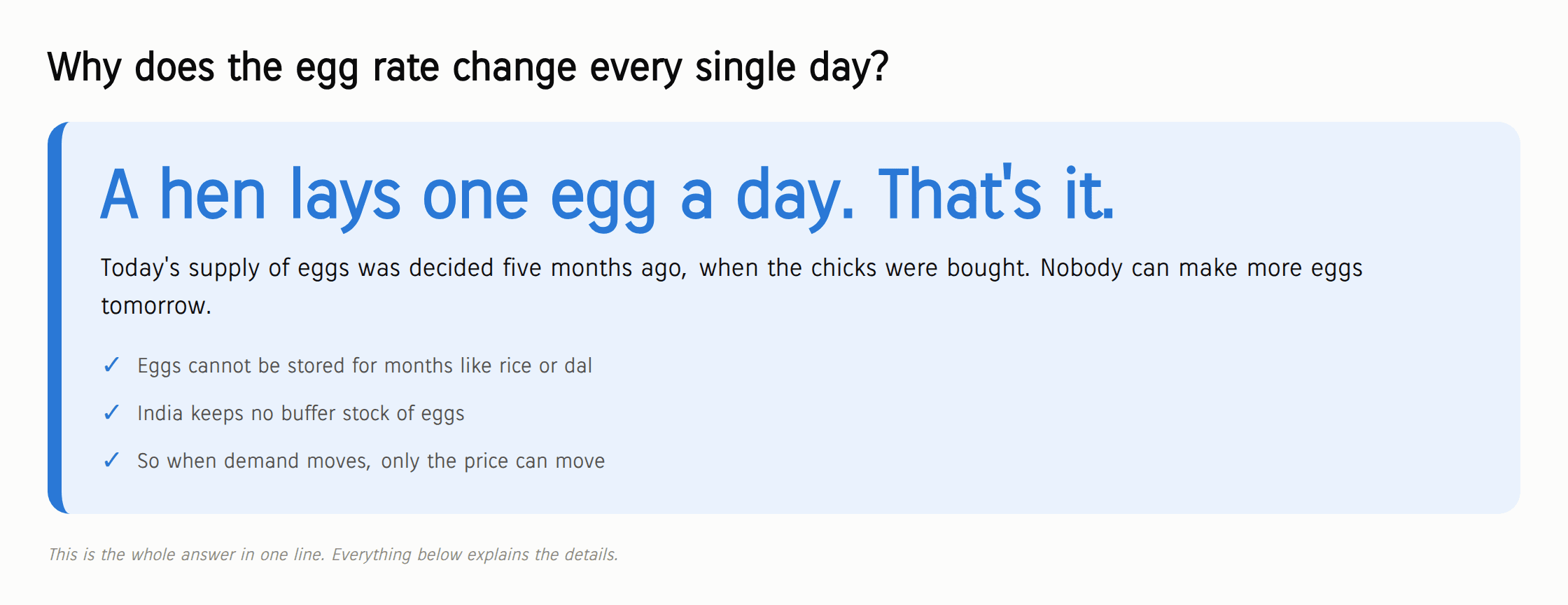
In one line: a hen lays one egg a day, eggs cannot be stored for long, and India keeps no reserve stock. So when demand moves, the price is the only thing that can move.
इस लेख का हिंदी संस्करण भी है — अंडे का रेट रोज़ क्यों बदलता है?
Think about rice. If rice gets expensive, a trader can open a godown and release old stock. If it gets cheap, he can store it and wait.
You cannot do that with eggs. Today’s eggs must sell today or tomorrow. And you cannot make extra eggs tomorrow, because the number of hens laying right now was decided about five months ago, when the chicks were bought.
That is the whole reason. Everything below is detail.
Five things that push the rate up and down
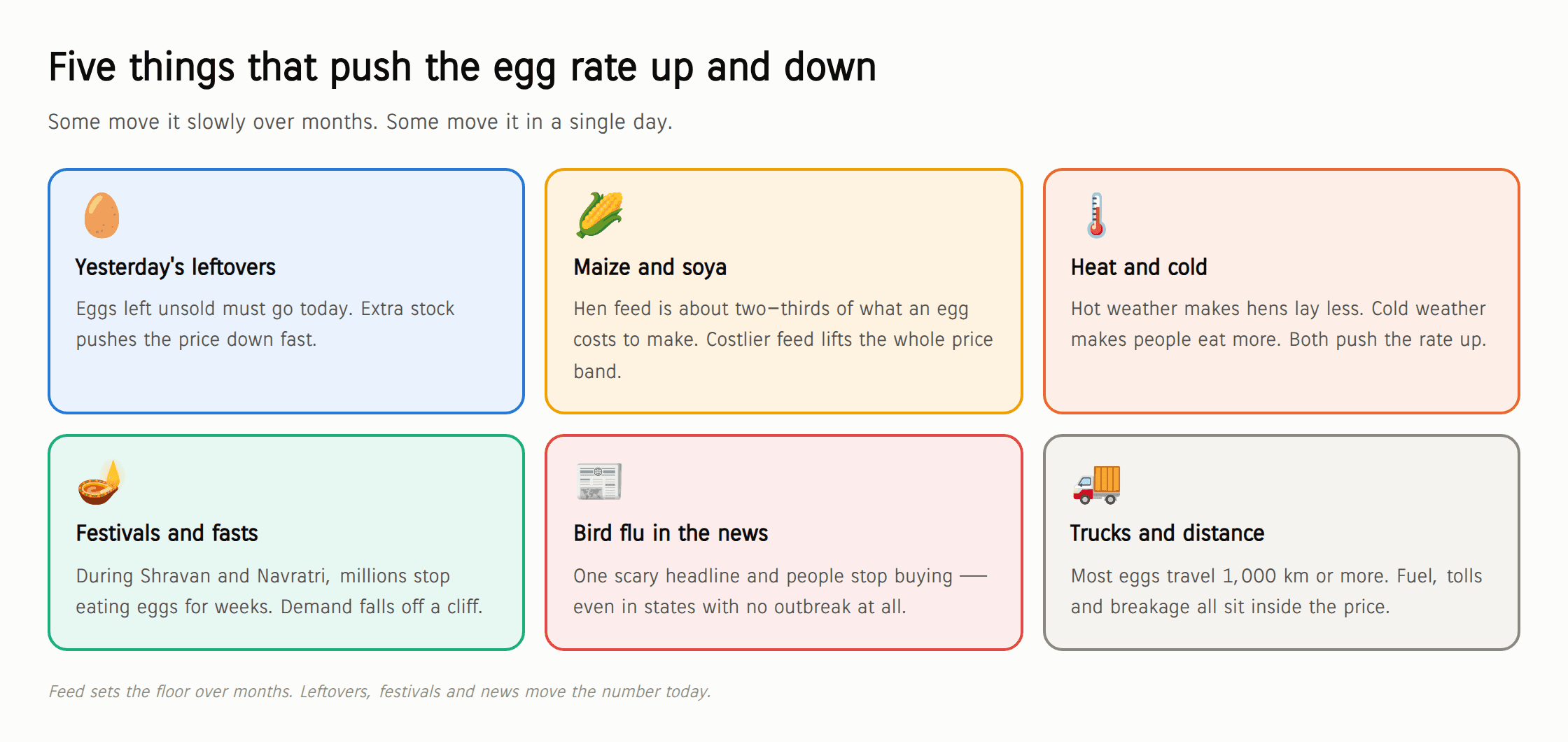
Some of these work slowly. Feed prices take weeks to show up. Others work in a single day — one bird flu headline can empty a market by evening.
What a normal week looks like
Most days, the rate moves by about one paisa per egg. That sounds tiny. But across a month those small moves add up, and a bad festival season can knock 25–30% off the price in two weeks.
As a live reference point: the average NECC suggested rate across 24 markets on 17 September 2026 was ₹573 per 100 eggs — ₹5.73 an egg. You can watch the same number move day by day on our price history since 2009.
On the same day, the price is different everywhere
This is the part that surprises people. On a single day — 10 August 2026 — an egg cost ₹6.00 in Chennai and ₹5.11 in Barwala. Same country, same morning, same egg.
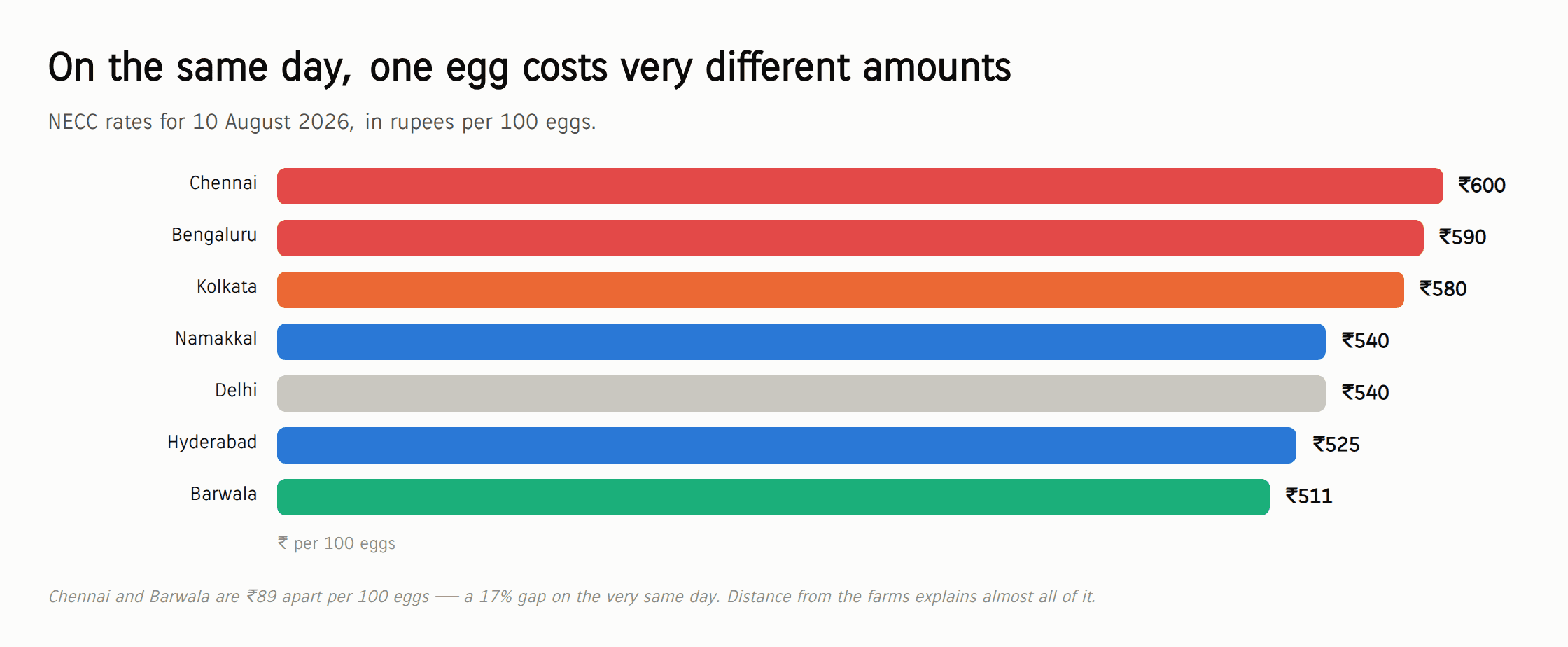
The reason is distance. India’s eggs come from a few areas — Namakkal in Tamil Nadu, coastal Andhra Pradesh, Telangana, and Barwala in Haryana. If you live in one of those places, eggs are cheap. If you live far away, every egg has come by truck, and you pay for that ride.
Where the money in one egg actually goes
Feed is about two-thirds of the cost. A hen eats maize and soya every single day, whether egg prices are good or bad.
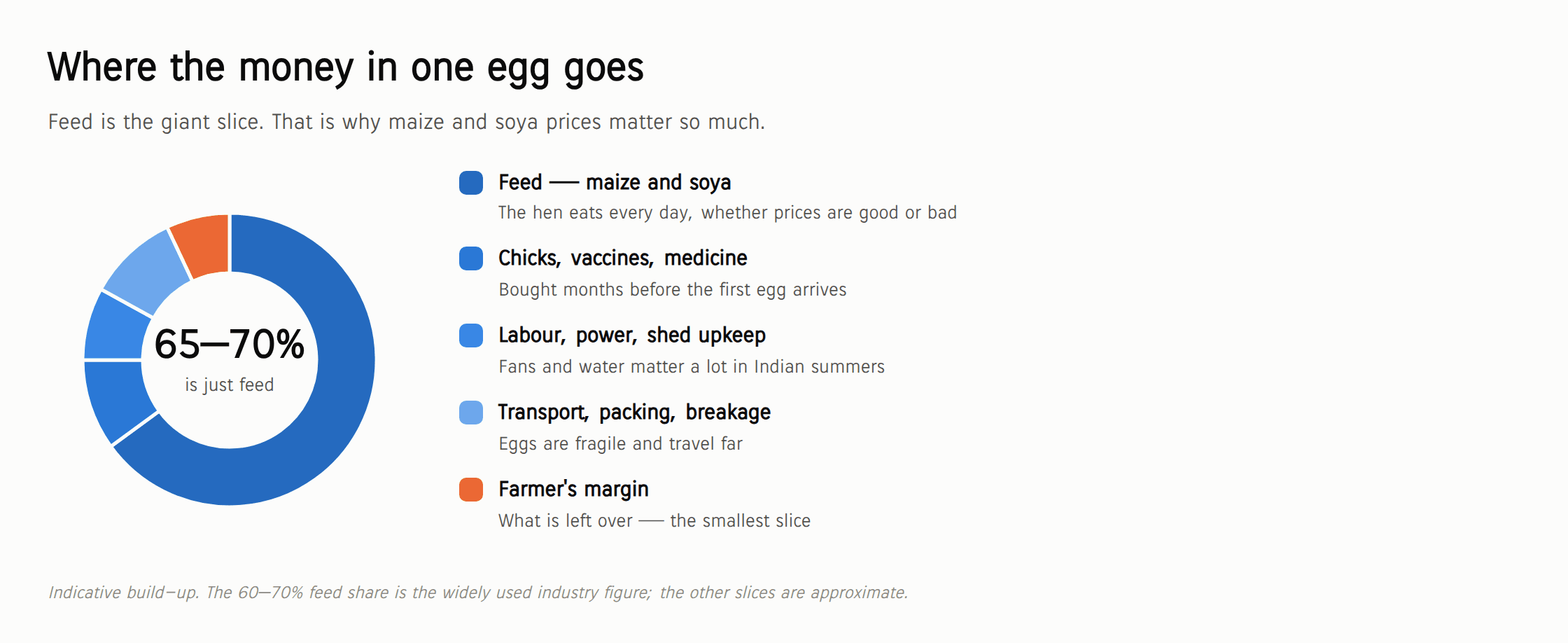
So when maize gets expensive, the farmer has two choices: raise the price or lose money. This is why the egg rate follows the maize rate — with a delay of some weeks.
A real example: what Shravan did to the price
This is the clearest example of the whole idea. In August 2026 in Nagpur there was no bird flu, no bad weather, and no jump in feed cost. The only thing that happened was Shravan — a month when millions of people stop eating eggs.
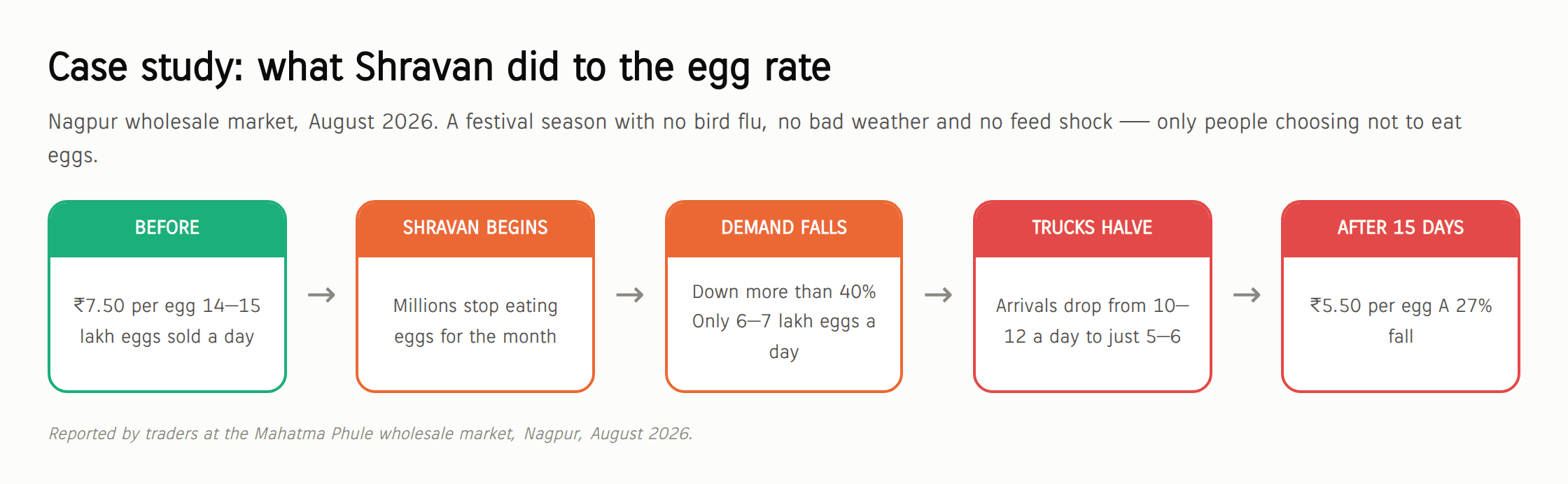
Demand fell more than 40%. The hens kept laying exactly as before. Nobody could store the extra eggs. So the price fell — traders at Nagpur’s Mahatma Phule wholesale market reported ₹7.50 an egg falling to ₹5.50 in fifteen days, with truck arrivals halving.
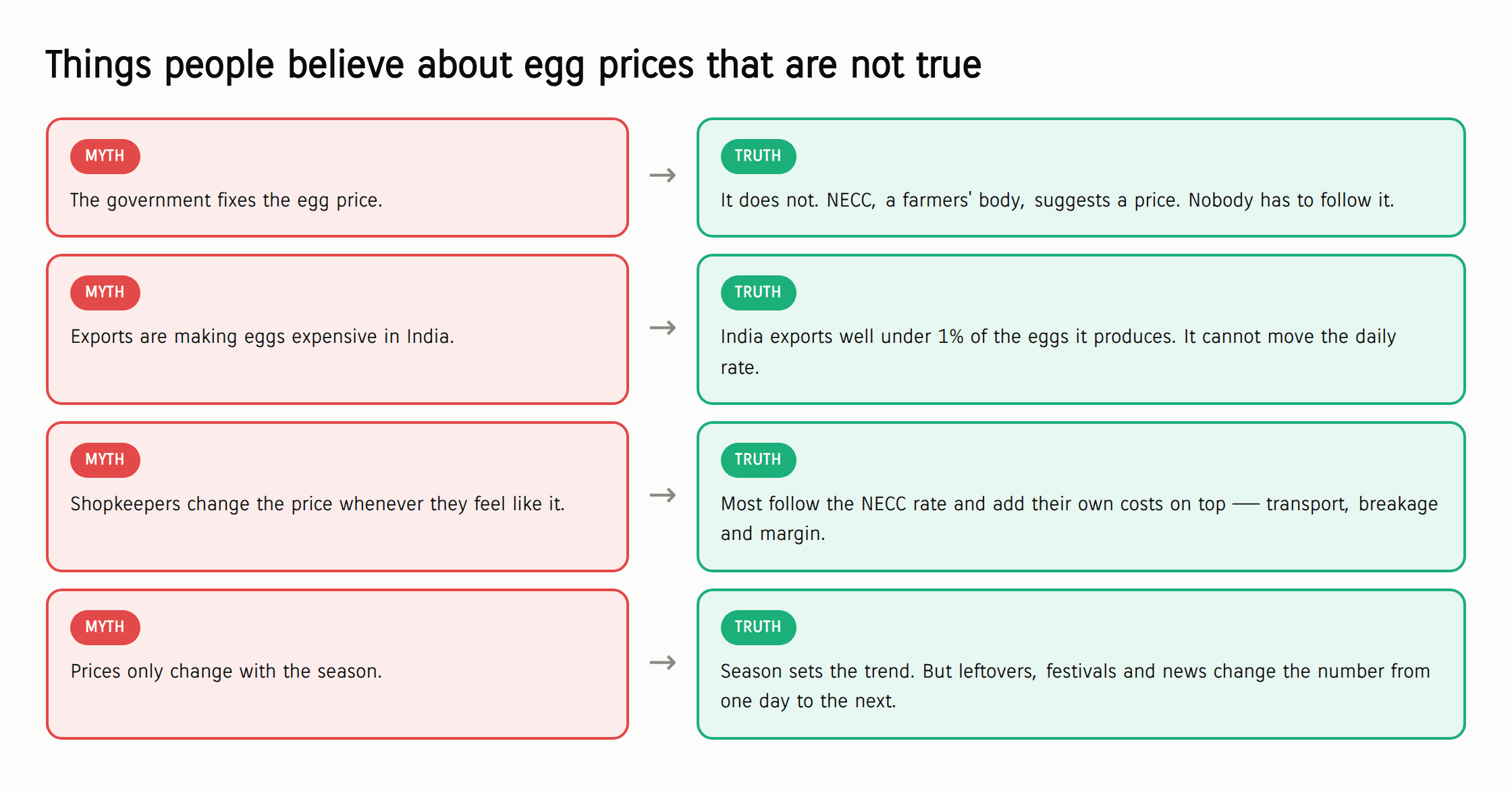
Four things people believe that are not true
Quick answers
If nobody is forced to follow the NECC rate, why does everyone use it?
Because it is the only daily number the whole trade can see. NECC — a farmers' body, with no government role — suggests a rate for each big market, and the Competition Commission of India confirmed in its order of 14 January 2022 that those rates are suggestive, not mandatory. A shared reference point is what stops every buyer and seller having to negotiate from scratch each morning.
Why is the egg rate different in my city?
Because of how far your city is from the poultry farms. India's eggs come from a few clusters — Namakkal, coastal Andhra Pradesh, Telangana and Barwala — and every kilometre of truck, fuel, tolls and breakage sits inside the price you pay.
Does the egg rate change on Sunday?
Rates are published on most days. Weekend demand can be higher, which sometimes lifts the price slightly.
Will egg prices go up next month?
Nobody can say for sure, and we do not predict. What the archive shows is a pattern: prices usually rise from November and peak in December, then fall to their lowest around March and April.
Why did the price fall even though feed got costlier?
Because demand fell faster. Cost sets the floor; demand sets the number. During Shravan, demand wins.
Do exports make eggs expensive in India?
No. India exports well under 1% of the eggs it produces — about USD 92 million in FY2023-24. It is far too small to move the daily rate.